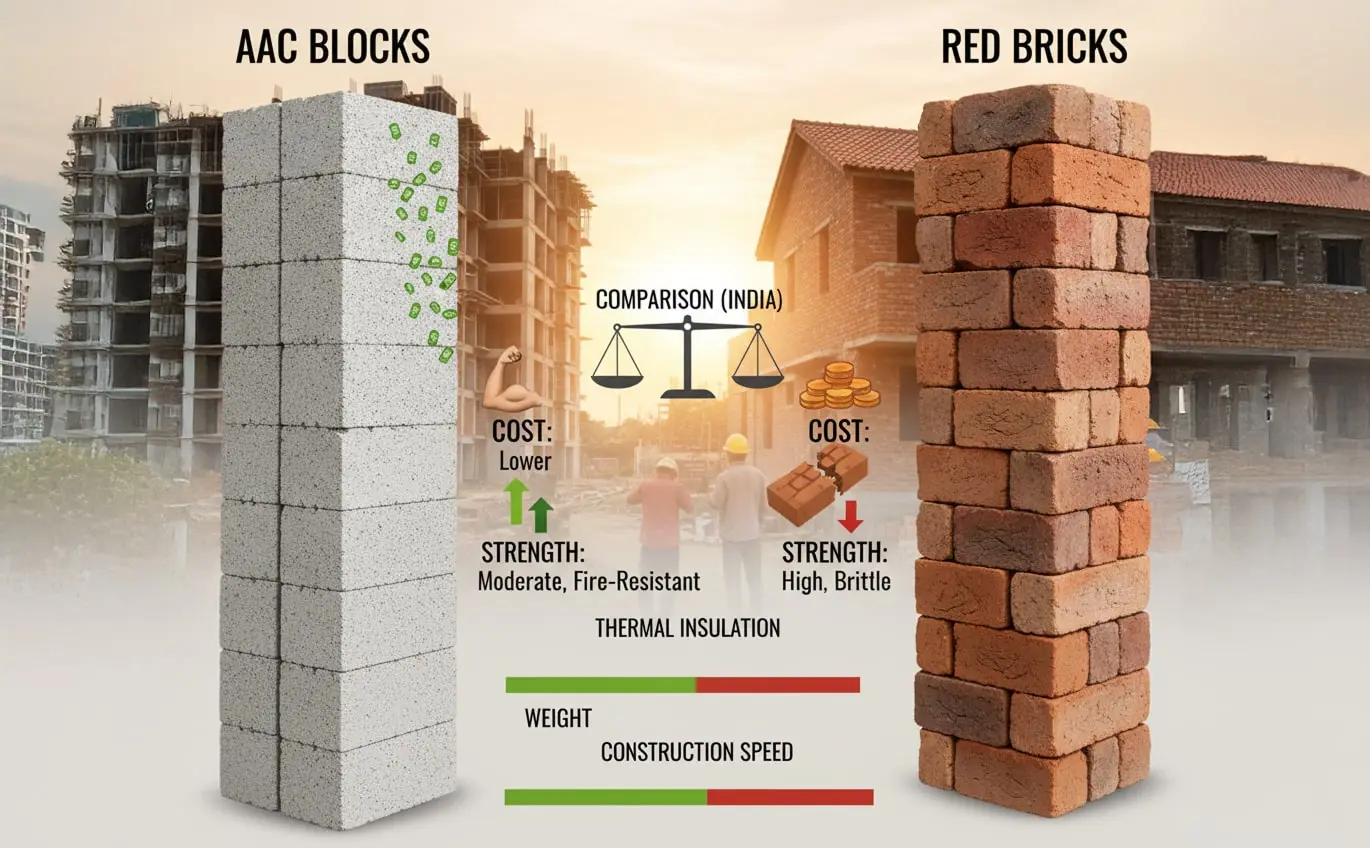

Choosing the right wall material is one of the most important decisions in construction. In India, AAC blocks and red bricks are the two most commonly used options for residential and commercial buildings.
While red bricks have been used for decades, AAC (Autoclaved Aerated Concrete) blocks are increasingly popular due to modern construction requirements such as speed, insulation, and sustainability.
This blog compares AAC blocks vs red bricks based on cost, strength, durability, construction efficiency, and suitability for Indian conditions.
What Are AAC Blocks?
AAC blocks are lightweight, precast concrete blocks made from cement, lime, fly ash, sand, and aluminum powder. They are cured under high pressure and temperature.
Key Features of AAC Blocks
- Lightweight and porous
- High thermal insulation
- Fire-resistant
- Eco-friendly (uses industrial waste like fly ash)
What Are Red Bricks?
Red bricks are traditional burnt clay bricks made from natural soil and fired in kilns.
Key Features of AAC Blocks
- High compressive strength
- Widely available
- Familiar construction method
- Durable and long-lasting
Cost Comparison: AAC Blocks vs Red Bricks (India)
AAC Blocks Cost
- ₹3,500 – ₹5,500 per cubic meter
- Lower plaster and mortar costs
- Reduced structural steel requirement due to lighter weight
Red Brick Cost
- ₹6 – ₹10 per brick (varies by region)
- Higher cement and sand consumption
- Higher structural load cost
Overall: AAC blocks may look expensive initially, but total construction cost is often lower.
Strength & Durability Comparison
- Red bricks have higher compressive strength and are suitable for load-bearing walls.
- AAC blocks are ideal for framed structures (RCC buildings), which are common in modern construction.
Most residential and commercial projects today use AAC blocks with RCC frames for better performance.
Which Is Better for Indian Construction?
Choose AAC Blocks If:
- You want faster construction
- You need better heat insulation (hot climates)
- You are building multi-storey RCC structures
- You want eco-friendly construction
Choose Red Brocks If:
- You prefer traditional construction
- Skilled AAC block labor is unavailable
- You are building small or load-bearing structures
Sustainability & Energy Efficiency
AAC blocks reduce:
- Air-conditioning costs
- Carbon footprint
- Water usage during construction
This makes them ideal for green buildings and sustainable real estate projects in India.
Expert Recommendation
For modern residential and commercial buildings, AAC blocks are generally the better choice, while red bricks remain suitable for specific traditional applications.
At Bluewing DCPL, material selection is based on project design, location, budget, and long-term performance.
FAQs: AAC Blocks vs Red Bricks
Red bricks have higher compressive strength, but AAC blocks are strong enough for RCC-framed structures.
AAC blocks cost more per unit, but reduce overall construction cost due to lower mortar, plaster, and steel usage.
Yes. AAC blocks perform well in hot climates due to excellent thermal insulation.
No. AAC blocks have uniform shape and size, reducing chances of cracks when installed correctly.
For modern houses, AAC blocks are usually better, while red bricks suit traditional or load-bearing designs.