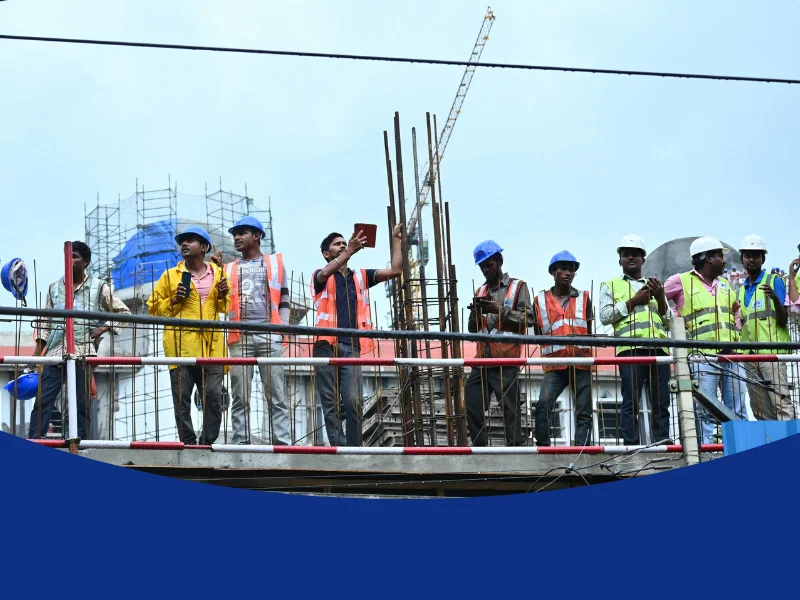

On most sites today, the skyline may be busy, but the ground tells another story.
Cement mixers hum, cranes move steel, yet entire sections of projects slow down because a few critical hands are missing. India’s construction boom has the momentum, but not always the manpower.
In the first two parts of our series, we explored how a growing labor shortage is reshaping the construction landscape and the mounting costs it brings in wages, quality, and timelines.
In this part, we shift focus from challenges to solutions: how can India’s builders bridge the labor gap and keep the nation’s growth story on track?
Rethinking Labor as a Strategic Resource
For years, labor planning was treated as an operational detail- a number to fill in the schedule. But in today’s environment, it demands strategic attention.
Forward-looking developers are now forecasting workforce availability by trade, region, and phase, just as they plan for materials or machinery.
They’re:
- Mapping manpower demand months in advance.
- Building reliable networks of skilled subcontractors.
- Creating retention programs to reduce mid-project attrition.
Labor is no longer a variable to manage but it’s a resource to protect, nurture, and plan for strategically.
Attracting Younger Generation
India’s construction workforce is ageing, and younger generations are steering toward tech, logistics, and gig-economy jobs. The perception of construction as “hard labor” needs to change to something like “skilled craft”.
To attract young talent, the industry must reframe construction as a modern, tech-driven profession. Here’s how the shift begins:
- Start early- Introduce vocational programs in schools that mix classroom learning with site experience.
- Show the growth- Use digital media to highlight real career paths, from apprentice to site engineer.
- Bridge digital and physical- Integrate drones, AR models, and project apps into training to align with the skills today’s youth value.
Building Skills for a Tech-Driven Construction Future
Technology and talent must grow together. While automation, drones, BIM, and project management software are transforming construction, their true impact depends on how well people are trained to use them.
The next phase of India’s construction growth will not be about replacing labor with machines- but about empowering people with smarter tools. Upskilling programs that blend technical know-how with hands-on site experience can help workers move from repetitive tasks to high-value roles.
Training initiatives should go beyond safety drills and equipment use. They should include modules on digital site coordination, data-based decision-making, and sustainability practices- areas that make today’s workforce ready for tomorrow’s projects.
Partnerships between builders, technology providers, and training institutes can accelerate this transition. When masons learn to read digital blueprints, supervisors use project tracking apps, and engineers operate drone surveys, efficiency becomes a collective skill- not just a company asset.
Ultimately, technology and training must evolve side by side. Because it’s not the machines that will build India’s next skyline, it’s people, empowered by technology.
Collaboration Across the Value Chain
The labor shortage isn’t a problem one contractor can solve alone. Developers, builders, and training institutions must align to build a sustainable ecosystem.
Emerging practices include:
- Joint skill-development programs funded by industry associations.
- Partnerships with NGOs and state labor departments for training and certification.
- Regional labor pools that allow contractors to share verified skilled resources across projects.
Collaboration shifts the narrative from competition for workers to collective workforce development- ensuring growth for the entire sector.
The Human Factor: Building with People in Mind
Behind every crane, drawing, and timeline are people- skilled, ambitious, and essential.
India’s next construction leap will depend as much on nurturing its workforce as on securing capital or materials.
Bridging the labor gap is not just about filling vacancies; it’s about recognizing that human capability is the foundation of every project.
Those who build with this understanding will lead not only in output, but in quality, trust, and longevity.
Final Thoughts
The construction labor shortage is a real test but it’s also an opportunity to rebuild how the industry values its people.
By treating labor as a strategic resource, embracing technology, and attracting the next generation with pride and purpose, India’s builders can turn a shortfall into strength.
The future of construction won’t be defined by how fast we build, but by how sustainably and intelligently we build with people at the centre of progress.