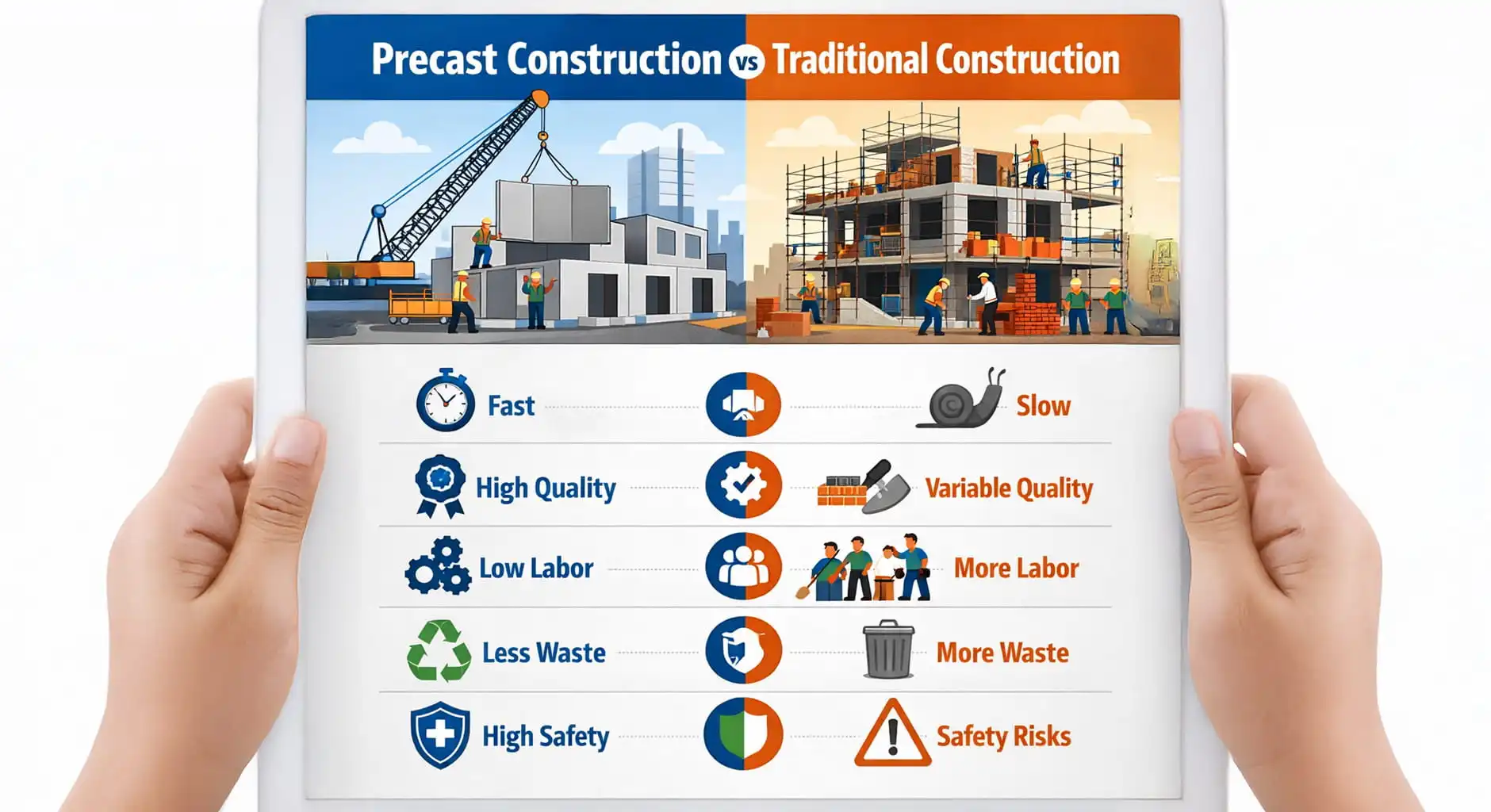

India’s construction industry is evolving rapidly due to increasing urbanization, infrastructure development, and the demand for faster project delivery. Traditional construction methods often struggle to meet tight timelines and quality expectations. This is where precast construction is gaining significant attention.
Precast construction involves manufacturing structural elements such as walls, beams, columns, slabs, and staircases in a controlled factory environment and then transporting them to the construction site for installation.
From residential projects to large-scale infrastructure, precast technology is becoming a preferred construction method across India. Let’s explore the top 10 advantages of precast construction and why it is shaping the future of the Indian construction industry.
1. Faster Construction Speed
One of the biggest advantages of precast construction is the significant reduction in project timelines.
Since precast components are manufactured in factories while site preparation work is ongoing, multiple activities happen simultaneously. Once the components arrive on site, they can be quickly assembled using cranes and lifting equipment.
This parallel process can reduce construction time by 30–50% compared to traditional methods.
For large projects such as housing developments, metro stations, and commercial buildings, this speed advantage is a major benefit.
2. Consistent and Superior Quality
Precast elements are manufactured in controlled factory environments where strict quality control measures are implemented.
Unlike traditional on-site construction, factory production ensures:
- Uniform material quality
- Accurate dimensions
- Controlled curing conditions
- Reduced human error
This results in high-strength and durable components, which improves the overall structural performance of the building.
3. Reduced Dependency on Site Labor
Labor shortages are a growing challenge in the Indian construction sector. Precast construction helps address this issue by shifting most of the work from the site to the factory.
Since precast elements are manufactured in plants using specialized machinery, the need for large on-site labor teams is significantly reduced.
This not only improves productivity but also reduces risks associated with labor availability and site management.
4. Improved Construction Safety
Construction sites often involve risks such as working at heights, heavy material handling, and unpredictable weather conditions.
Precast construction improves safety because:
- Most activities occur in controlled factory environments
- On-site work is limited to installation and assembly
- Reduced scaffolding and formwork is required
As a result, the number of accidents and safety hazards at the site is minimized.
5. Reduced Construction Waste
Traditional construction methods generate significant material waste due to on-site cutting, rework, and excess materials.
Precast manufacturing follows precise production processes, which minimize waste generation.
Additionally, leftover materials can often be reused within the factory production cycle. This contributes to better resource efficiency and cost savings.
6. Better Project Cost Control
Although precast construction may require initial investment in plant infrastructure, it often results in better cost control over the entire project lifecycle.
Key cost benefits include:
- Reduced labor costs
- Shorter project timelines
- Lower material wastage
- Improved construction efficiency
For large-scale developments, these savings can be substantial.
7. Enhanced Structural Durability
Precast components are designed and manufactured with high precision, ensuring superior structural strength and durability.
Controlled curing processes allow concrete to achieve optimal strength and long-term performance. This makes precast structures more resistant to environmental factors such as weather, corrosion, and wear.
As a result, buildings constructed using precast technology often have longer service life and lower maintenance requirements.
8. Minimal Weather Impact
Weather conditions such as rain, heat, and humidity often cause delays in traditional construction.
Since precast components are manufactured indoors in factories, production continues regardless of weather conditions.
This significantly reduces project delays and ensures more predictable construction schedules.
9. Design Flexibility
Modern precast technology offers significant design flexibility. Architects and engineers can create a wide range of structural and aesthetic designs using precast elements.
Precast components can be customized for:
- Residential buildings
- Commercial complexes
- Industrial facilities
- Infrastructure projects
Advanced digital design tools also allow precise planning and integration with modern construction technologies.
10. Sustainable and Environmentally Friendly
Sustainability is becoming increasingly important in the construction industry. Precast construction contributes to environmentally responsible building practices in several ways:
- Reduced construction waste
- Efficient material usage
- Lower site disturbance
- Potential use of recycled materials
Additionally, faster project completion reduces energy consumption and environmental impact during construction.
These factors make precast construction an important solution for sustainable urban development in India.
Conclusion
Precast construction is transforming the Indian construction landscape by offering faster project delivery, improved quality, and sustainable building practices.
As infrastructure projects and urban housing demand continue to grow, the adoption of precast technology is expected to increase across India.
With benefits such as reduced labor dependency, enhanced safety, and better cost efficiency, precast construction is well-positioned to play a major role in the future of modern construction.
FAQs:
Precast construction is a building method where structural elements such as walls, beams, slabs, and columns are manufactured in a factory and then transported to the construction site for installation.
This approach improves construction speed, quality, and efficiency compared to traditional on-site concrete construction.
Precast construction is gaining popularity in India because it helps reduce project timelines, improves construction quality, and addresses labor shortages. It is particularly useful for large infrastructure projects, housing developments, and commercial buildings.
Precast construction can be more cost-effective for large projects because it reduces labor costs, minimizes material waste, and shortens construction schedules. While initial setup costs may be higher, the overall project cost can be optimized.
Precast construction is used in many types of projects, including:
Residential buildings
Commercial complexes
Industrial facilities
Bridges and flyovers
Metro rail infrastructure
Parking structures
Yes, precast construction supports sustainable building practices. Since components are manufactured in controlled factory environments, material waste is reduced, resources are used efficiently, and construction sites experience less environmental impact.
Precast components are produced under strict quality control in factories where material proportions, curing conditions, and production processes are carefully monitored. This ensures consistent strength, durability, and dimensional accuracy.
Yes. Precast construction allows site preparation and component manufacturing to occur simultaneously. Once components arrive at the site, they can be quickly assembled, significantly reducing project timelines.