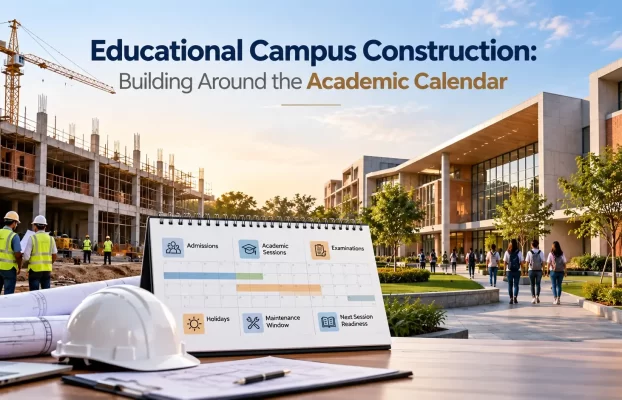

Most construction deadlines are negotiable under pressure. A campus deadline is not.
If a new academic block is not ready when the session begins, the institution has students with nowhere to sit. There is no equivalent of phased occupancy or a short extension — the date is set by the academic calendar, it was published months in advance, and it does not move because a contractor is behind.
That single constraint shapes everything about how an education project should be planned.
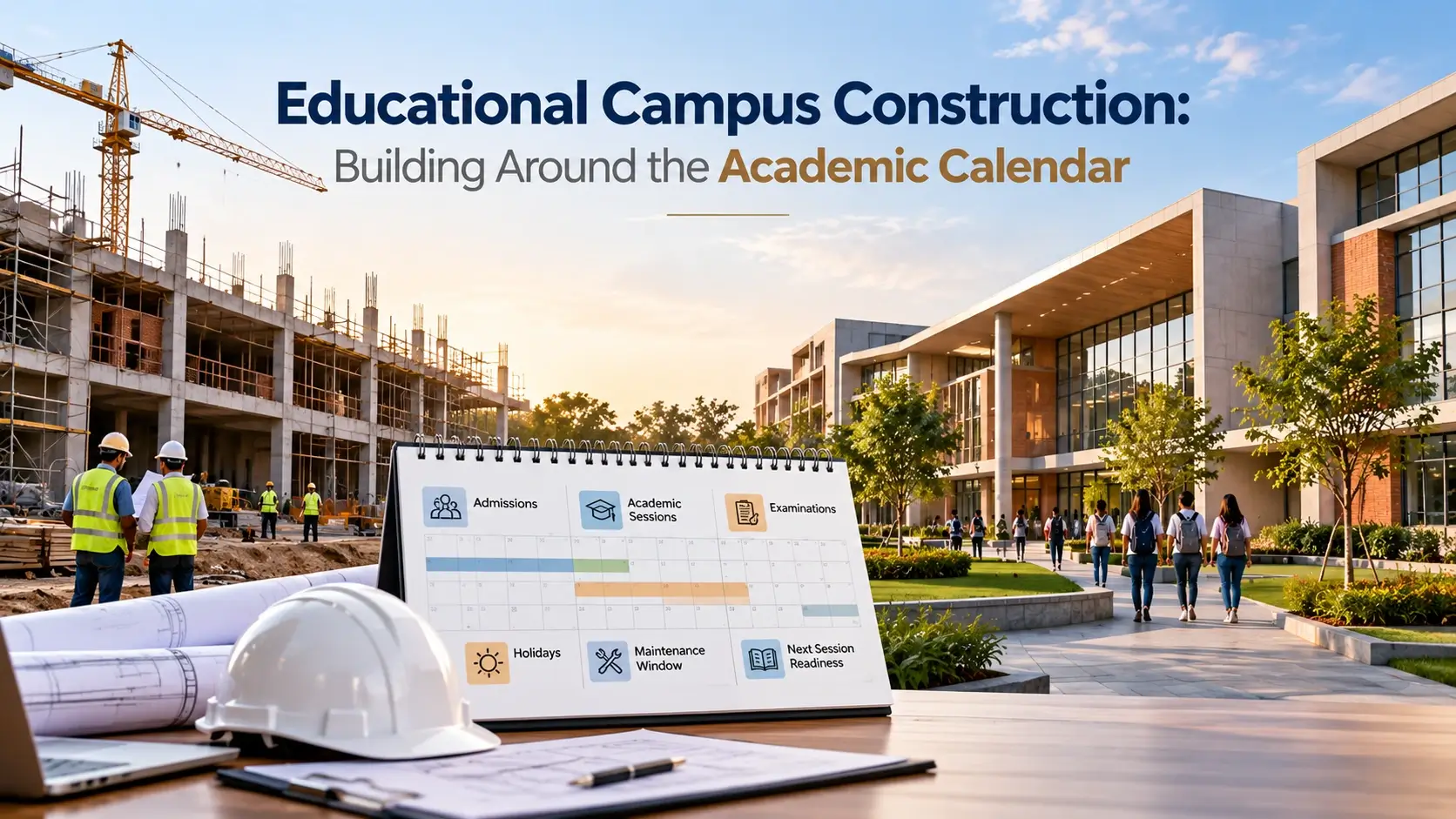
The vacation window governs the programme
Work on an operating campus falls into two categories: what can be done while students are present, and what cannot.
Anything disruptive — demolition, structural work adjacent to occupied blocks, major services shutdowns, heavy material movement through campus — generally has to happen during vacation. That window is fixed, usually short, and if it is missed the work waits until the next one.
The planning implication is straightforward but frequently missed. Project sequencing should be built backwards from the vacation windows rather than forwards from the start date. Identify what must happen in each window, confirm that it fits, and only then set the overall programme. A sequence planned forwards will usually arrive at a vacation window with the wrong activity ready.
It also means long-lead procurement matters more here than on most project types. A material with a three-month lead time ordered late does not simply delay the work by three months — it can push an activity past a vacation window and delay it by six.
Working safely with students on site
A campus under construction is a site with several thousand untrained people on it, many of them young, none of them under the contractor’s supervision. This is a materially different safety proposition from a closed site.
What it requires in practice:
- Hard physical separation between construction and campus areas — solid hoarding rather than tape or mesh, with no informal routes through the work area
- Separate vehicle access for construction traffic, kept away from student movement routes entirely
- Material movement scheduled outside class change times, when corridors and paths are busiest
- Overhead protection where any work takes place above or beside a route in use
- Noise management around examination periods, which in practice often means stopping certain activities altogether
The examination point deserves emphasis because it is the one most often overlooked at planning stage. Examination periods are fixed, they are non-negotiable, and noisy work during them will be stopped. Build them into the programme at the outset rather than discovering them in week twenty.
Different buildings, different demands
A campus is not one building type. The requirements vary sharply by facility, and each carries its own risk to the programme.
Laboratories are the most services-intensive buildings on a campus — fume extraction, gas lines, specialised drainage, power redundancy and bench services. They need design coordination closer to a healthcare project than to a classroom block, and the services often govern the structural sequence.
Auditoriums and lecture theatres bring long structural spans, raked floors, acoustic requirements and significant AV and HVAC provision. The span requirement in particular may push the structural solution in a different direction from the rest of the campus.
Hostels are highly repetitive, which makes them well suited to precast construction or system formwork. They also carry heavy plumbing and sanitary loads, and a fixed occupancy date that is usually the same as the session start.
Classroom and administrative blocks are closest to conventional commercial work, and are usually where programme recovery is possible if it is needed elsewhere.
Planning a campus as a single uniform project underestimates the laboratory and auditorium elements, which are where the programme risk concentrates.
Expansion is the normal condition
Very few campus projects are greenfield. Most are additions to a campus that has grown over years, and that carries specific implications.
Existing services need tracing before excavation, since campus utility records are frequently incomplete or out of date. New buildings connect into existing water, power and drainage networks that may already be at capacity. Architectural consistency with existing buildings is often a requirement rather than a preference. And the new structure has to work with circulation patterns that already exist — a building that is correct in isolation but awkward to reach is a poor outcome.
A practical recommendation: survey and trace existing services before finalising the foundation design, not after excavation starts. Unmarked services discovered mid-excavation are a common source of delay on campus projects specifically, because the records are so often unreliable.
Planning an education project
Five things worth settling early:
- Fix the handover date to the academic session, then plan backwards from it rather than forwards from the start
- Map the vacation windows across the full project duration and assign the disruptive work to them
- Identify long-lead items early — on a campus project, a missed lead time can cost a whole vacation window
- Agree the safety interface with the institution in writing, covering separation, access routes and restricted periods
- Survey existing services before the foundation design is finalised
At BlueWing, we deliver institutional projects on a turnkey construction basis, and the projects we have delivered include educational work for clients including Parul University. Our precast division also supports repetitive building types such as hostel blocks where programme certainty matters.
Planning a campus building or expansion? Talk to our team early — on an education project, the sequencing decisions made before work starts matter more than almost anything that happens afterwards.
FAQs:
Yes, and most campus projects are executed this way. It requires hard physical separation from student areas, separate construction vehicle access, material movement scheduled outside class change times, and restrictions around examination periods.
By planning backwards from the session start rather than forwards from the project start. Disruptive activities are assigned to vacation windows, which are fixed and usually short, and the rest of the sequence is built around them.
Laboratories, because of fume extraction, gas lines, specialised drainage and power redundancy, and auditoriums, because of long structural spans, raked floors and acoustic requirements. Hostels and classroom blocks are more straightforward.
It suits highly repetitive buildings such as hostel blocks particularly well, where identical units allow mould cost to be spread and the programme benefit is real. It suits laboratories and auditoriums less well, where elements vary.
Missing a vacation window, usually because of a long-lead item ordered late or a sequencing decision made forwards rather than backwards from the session date. Unmarked existing services discovered during excavation are the second most common cause.