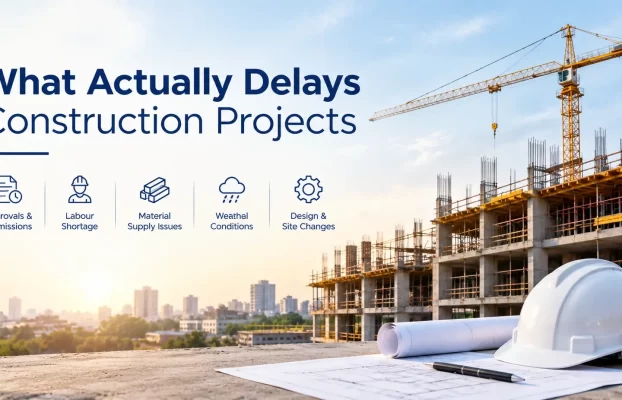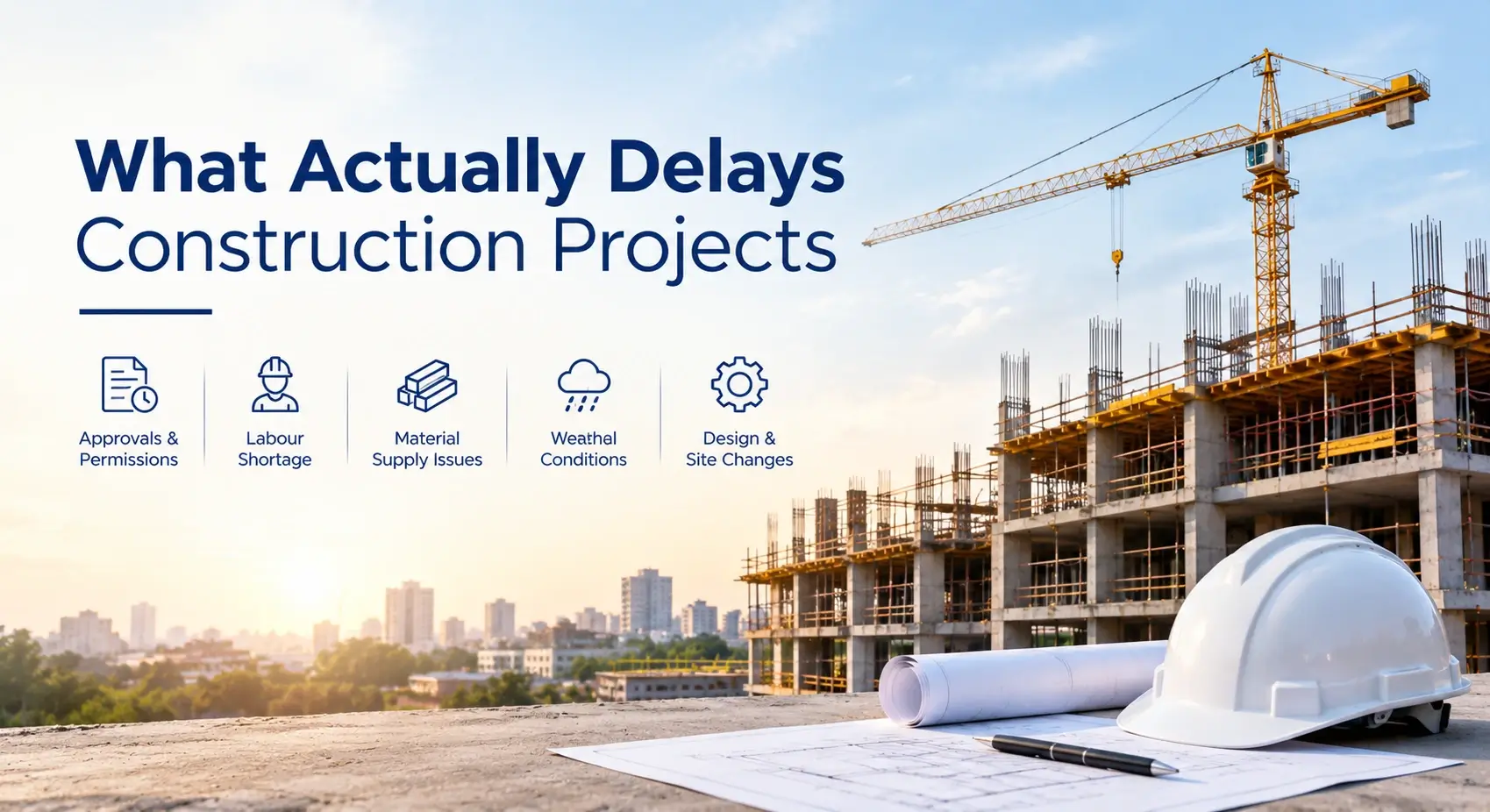

Most construction delays are blamed on the contractor. Some of them are the contractor’s fault.
But when a project runs six months late, the cause is rarely a single failure. It is usually a sequence of smaller delays, most of which were predictable, and several of which originated well before the contractor was appointed.
This article sets out what actually causes delay, roughly in order of how much time it accounts for — and, more usefully, which causes can be removed in advance and which can only be managed.
1. Design that was never finished
The largest single cause of delay is starting construction on a design that is not complete.
It happens for understandable reasons. The client wants to start, approvals are in hand, the foundation design is settled, and the reasoning is that upper floor details can be resolved while the substructure is built.
Sometimes that works. Often it does not, because design decisions are connected. A change to a service route affects slab penetrations. A revised layout affects column positions. A change made in month four turns out to contradict something built in month two.
The cost is not only the direct rework. It is the decision-waiting time — days where a crew has nothing to do because a detail has not been issued, which do not appear as a delay event anywhere but accumulate steadily.
What removes it: freezing the structural design before construction starts, and resolving services coordination before the slab it affects is poured. This is unglamorous and it is the highest-return thing a client can do.
2. Approvals
Approval timelines are treated as fixed inputs when they are largely variable, and they are frequently the cause of the first slippage in a programme.
Delay comes less often from the approving authority than from incomplete submissions, drawings that do not match regulations, revisions required after review, and the queue position a resubmission goes to.
Multi-level basements, industrial projects and buildings above certain heights attract additional scrutiny — fire safety, environmental clearance, and pollution control consent each carry their own timeline.
What removes it: engaging the approval position at design stage rather than after drawings are complete, and submitting complete applications first time. A resubmission usually costs more calendar time than the extra week spent getting the first one right.
3. Material lead times
Not all materials are available on demand, and the ones with long lead times are rarely on anyone’s critical path until they are.
Structural steel in specific sections, imported fittings, lifts and escalators, specialist facade systems, and large electrical equipment can carry lead times running to several months. Cement and aggregate rarely cause delay. The items that do are usually the ones ordered late because they are needed late.
The sequencing error is common: a lift with a four-month lead time ordered when the shaft is ready, rather than four months before.
What removes it: identifying long-lead items at the start of the project and placing orders against the programme rather than against site readiness.
4. Labour availability and the festival season
Labour availability in Gujarat is seasonal, and it is predictable enough that it should never be a surprise.
The most significant period is Navratri through Diwali. A substantial proportion of the workforce returns home, and many do not return immediately afterwards. Depending on the trade and the source region, a site can be operating at reduced strength for several weeks around the festival period, with a further ramp-up period after.
Monsoon has a different effect — work continues, but slows. Excavation, external work and concrete pours are all affected, and the overall rate of progress falls even on a well-managed site.
What removes it: planning around it rather than through it. Practically, that means scheduling labour-intensive activities outside the festival window, completing critical path items before the break rather than assuming they will continue through it, and building a realistic ramp-up period into the programme rather than assuming full strength returns on day one.
A programme that assumes uninterrupted full-strength working through October and November is not a programme. It is a hope.
5. Payment cycles
This one is rarely discussed openly and accounts for more delay than its visibility suggests.
Construction runs on working capital. A contractor who is not paid on time cannot pay suppliers on time, which affects material deliveries. They cannot pay labour on time, which affects retention of crews. And they will, reasonably, prioritise sites where payment is current.
Delayed certification has the same effect as delayed payment. A bill that sits unapproved for three weeks is a three-week working capital gap.
What removes it: a realistic payment schedule agreed at contract stage, certification turned around within the agreed period, and disputed items separated from undisputed ones so that a disagreement over one item does not hold up payment for the rest.
6. Contractor capacity
A contractor operating beyond capacity will deliver worse results than a smaller firm with room for your project.
The symptoms are recognisable: the project manager is running several sites and visits yours twice a week, key decisions wait for someone who is not available, and crews are moved between sites according to which client is complaining loudest.
This is worth checking before appointment rather than discovering afterwards. When choosing a contractor, ask what their current order book looks like and where your project would sit in their priorities. It is the question clients most often skip and most often regret.
7. Site conditions that were not investigated
Ground conditions that differ from what was assumed are a common source of delay, and they are usually discovered at the worst possible moment — after excavation has started.
Unexpected water, poor bearing capacity, buried obstructions and rock all require design changes mid-execution, which means redesign time, revised approvals in some cases, and reprogramming.
What removes it: a proper geotechnical investigation extending below the proposed foundation level. It is a small cost against the risk.
8. Coordination between agencies
On a project with separate civil, MEP, facade and interior contractors, the interfaces between them are where time is lost. Each agency plans its own work well. Nobody owns the gaps.
Typical failures: the MEP contractor arrives to find the slab poured without the required sleeves, the facade contractor cannot start because the structural frame has a tolerance issue, the interiors contractor waits on services that wait on something else.
What removes it: either genuine coordination management by the client or their consultant, or a turnkey or EPC basis contract where a single contractor carries responsibility for the interfaces. This is the main argument for single-point delivery, and it is worth more on complex projects than the headline cost comparison suggests.
What this means in practice
Of the eight causes above, five are largely settled before construction begins: design completeness, approvals, long-lead procurement, contractor selection and site investigation.
That is the useful conclusion. Most of the delay in a construction project is determined by decisions taken before anyone arrives on site. Once construction is underway, the scope for recovery is limited — you can manage delay, but removing it is much harder than preventing it.
The three that remain live during execution — labour seasonality, payment cycles and interface coordination — are all manageable with planning that most projects simply do not do.
A closing observation. When a programme is compressed at tender stage to satisfy a target date, without any change to scope or resources, the delay is being scheduled rather than avoided. It will appear later, and by then it will cost more to address. A programme that is realistic at the outset is the cheapest form of delay prevention available.
At BlueWing, we work with clients on a turnkey or EPC basis where single-point accountability removes the interface coordination problem entirely.
Planning a project and want a realistic view of the programme?
FAQs:
Starting construction on an incomplete design. It generates both direct rework and a steady accumulation of decision-waiting time that rarely gets recorded as delay but adds up substantially.
Significantly. A substantial proportion of the workforce travels home around Navratri and Diwali, and return is staggered. Sites commonly run at reduced strength for several weeks, with a further ramp-up period afterwards.
Partly, through resequencing, additional resources or overtime — all of which cost money. Prevention is substantially cheaper than recovery, which is why the decisions made before construction starts matter more than those made during it.
It depends on the cause and on the contract. Contractor-caused delay usually attracts liquidated damages; client-caused delay usually entitles the contractor to an extension of time and often to cost. Most real delays involve contributions from both sides, which is why a clear contract and proper records matter.
Freeze the design before starting, engage approvals at design stage, order long-lead items early, investigate the ground properly, and appoint a contractor with the capacity to prioritise your project.