
Introduction
For decades, Indian highway and bridge projects leaned almost entirely on cast-in-situ concrete — poured, cured, and finished on site, one project at a time. That’s changing fast. A growing policy push toward precast construction is now steering how national highways, flyovers, and bridges get built, and it’s opening up real opportunities for contractors and precast manufacturers who are ready for it.
The Shift: Precast Goes from Option to Mandate
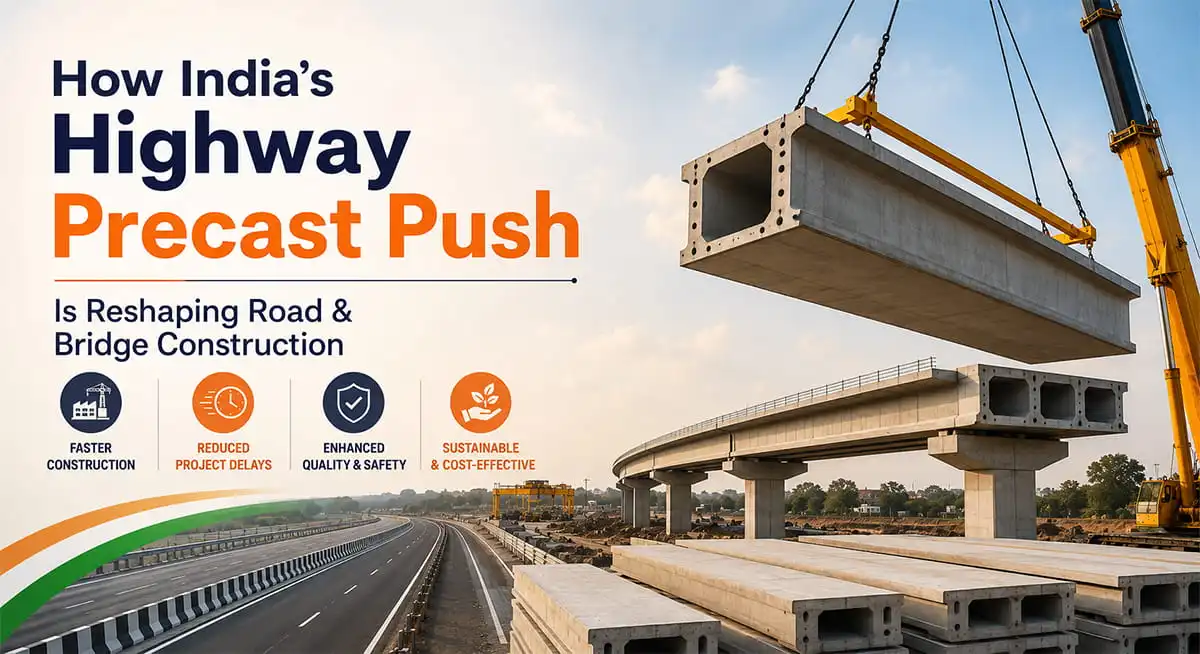
Highway authorities have been actively encouraging precast elements — girders, piers, deck slabs, culverts, and barrier walls — for new road and bridge projects, with policy direction pushing a meaningful share of new infrastructure toward factory-made components rather than on-site pours. The logic is straightforward: precast components are cast in a controlled plant environment, cured properly, quality-checked before they ever reach site, and then simply erected — cutting weeks off project timelines compared to conventional methods.
For a country racing to expand its highway network, that time savings matters. Projects that used to take months to reach structural completion can now move to installation in a fraction of the time, because the “waiting for concrete to cure” phase happens off-site, in parallel with other site work.
Why This Is Happening Now
A few forces are converging at once:
- Tighter project timelines. Government infrastructure programs run on aggressive completion targets, and precast is one of the few methods that reliably compresses schedules without compromising structural quality.
- Labor shortages. Skilled site labor is harder to source and retain than it used to be. Precast shifts a large share of the work into factory settings, where output is more predictable and less dependent on daily site labor availability.
- Quality consistency. Factory casting means consistent mix design, controlled curing, and easier quality checks — reducing the on-site defects and rework that often follow variable weather, water quality, or inconsistent site supervision.
- Scale of infrastructure spending. With record capital expenditure flowing into highways, metros, and industrial corridors, there simply isn’t enough site-labor capacity to build everything the traditional way. Precast is becoming the practical answer to that capacity gap.
Where the Gaps Still Are
It isn’t a frictionless shift. India’s precast industry is still working through a lack of unified national standards — codes and quality benchmarks vary somewhat from state to state and project to project, which creates inconsistency for manufacturers trying to scale across regions. Logistics is another real constraint: precast elements are large, heavy, and need careful transport planning, and delays in road connectivity between plant and site can eat into the time savings precast is supposed to deliver.
This is exactly why the choice of precast partner matters. A manufacturer with in-house design coordination, tested quality processes, and reliable logistics planning can deliver on precast’s promise; one without those systems can end up passing the old problems — delays, inconsistent quality — into a new format.
What This Means for Developers and Contractors
For anyone planning a highway, flyover, or bridge project in the current environment, precast is worth treating as a default consideration rather than an alternative to fall back on:
- Bring precast into planning early. The biggest time savings come when structural design accounts for precast elements from the start, not when it’s retrofitted onto a cast-in-situ plan midway through.
- Vet manufacturing capacity, not just pricing. Plant capacity, quality control processes, and transport logistics matter as much as the quoted rate per element.
- Plan for standardization where possible. Repeating standard element designs across a project (rather than custom-casting every piece) is where precast’s speed and cost advantage compounds.
The Bigger Picture
Highway and bridge construction is often where new methods get proven at scale in India, and precast’s growing role here is a signal for the wider construction industry — commercial, industrial, and residential included. As more infrastructure projects demonstrate precast’s timeline and quality advantages under real, high-stakes conditions, its adoption elsewhere is likely to accelerate too.
For turnkey construction companies already working across both conventional and precast methods, this is a genuine opportunity: the ability to offer clients a faster, more predictable build without compromising on structural integrity is becoming a real differentiator — not just a talking point.