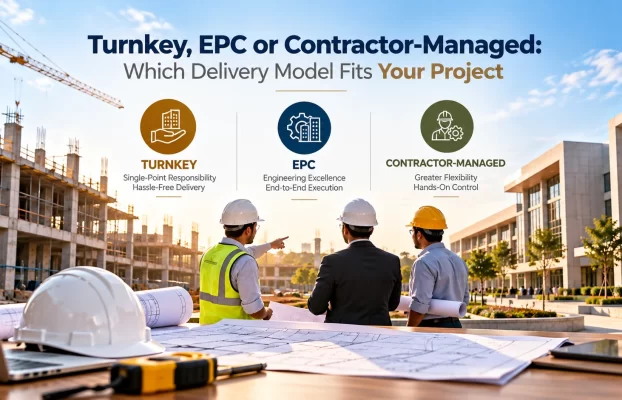

Before a client decides who builds their project, they have to decide how it will be built — specifically, how many agencies they will appoint and who carries responsibility for the gaps between them.
This decision gets less attention than contractor selection, and it has comparable consequences. It determines who carries which risk, how much cost certainty you have, how much of your own time the project will take, and what happens when something goes wrong between two parties.
There are three main models. None is universally better.
Contractor-managed: you appoint separately, you coordinate
In this model the client appoints the architect, the structural consultant, the civil contractor, the MEP contractor, the facade contractor and the interiors contractor separately, and manages the relationships between them — directly or through a project management consultant.
What you gain. Direct control over each appointment, the ability to select a specialist for each package, visibility of each party’s rate rather than a single bundled figure, and flexibility to change scope within a package without renegotiating the whole project.
What it costs you. Every interface between agencies becomes your responsibility. The MEP contractor arrives to find a slab poured without sleeves; the facade contractor cannot start because of a structural tolerance issue; the interiors contractor waits on services that wait on something else. Each party will have planned its own work competently. Nobody owns the gaps — except you.
It also demands real in-house capacity. Someone on the client side needs the technical knowledge to coordinate drawings, the authority to make decisions quickly, and the time to run the project. Where that capacity genuinely exists, this model works well and can be the most cost-effective. Where it does not, the savings on paper are usually consumed by delay.
Turnkey: one contractor, one defined scope, one price
A turnkey contract gives a single contractor responsibility for delivering a defined scope for a fixed price. The client provides the design; the contractor builds everything in the scope and hands over a completed facility.
What you gain. Cost certainty from the outset, since quantity risk sits with the contractor. One point of responsibility for delivery. Substantially less client-side management time. And interface problems between trades become the contractor’s problem rather than yours.
What it requires. A properly defined scope before the contract is signed. This is the condition most often underestimated. A turnkey contract prices what is in the documents — every ambiguity becomes a variation claim, and a loosely defined turnkey contract delivers neither cost certainty nor goodwill.
The practical test: if your drawings and specifications are complete enough that a competent contractor could price them without asking you a series of clarifying questions, turnkey will work. If they are not, fix that before tendering rather than after.
EPC: engineering, procurement and construction under one contract
An EPC contract extends the turnkey model backwards to include design. The contractor takes a performance requirement — what the facility must do — and delivers engineering, procurement and construction against it.
What you gain. A single point of accountability from design through commissioning. No gap between designer and builder, which removes a common source of dispute, since the party doing the design is the party who has to build it. Faster start, because detailed design and early construction can overlap. And on complex industrial facilities, the contractor carries responsibility for whether the completed plant performs, not just whether it matches a drawing.
What it requires. A clear performance specification. Instead of telling the contractor what to build, you are telling them what it must achieve — throughput, capacity, compliance, operating parameters. Writing that well requires its own expertise, and a vague performance specification produces the same problems as a vague turnkey scope.
You also give up some design control. If the appearance and detail of every element matters to you, EPC may frustrate that. For an industrial facility where function governs, it rarely does.
Comparing them directly
Four questions separate the three models:
- Who carries quantity risk? Contractor-managed: the client. Turnkey and EPC: the contractor.
- Who owns the interfaces? Contractor-managed: the client. Turnkey and EPC: the contractor.
- How much client-side capacity is needed? Contractor-managed: substantial. Turnkey: moderate. EPC: least.
- How complete must the design be at tender? Contractor-managed: can evolve. Turnkey: complete. EPC: performance requirements complete, detailed design not needed.
There is a reasonable heuristic here. The less technical capacity you have in-house, and the more your project depends on complex interfaces between systems, the more single-point accountability is worth paying for. The more capacity you have, and the simpler the building, the more a separated approach can save.
On the cost comparison
Single-point models usually show a higher headline figure, because the contractor is pricing risk the client would otherwise carry. That premium is sometimes described as inefficiency. Often it is not.
The honest comparison includes the cost of client-side management time, the cost of delays caused by interface failures, the cost of variations arising from coordination gaps, and the cost of disputes between agencies where responsibility is unclear. These rarely appear in a tender comparison and they are real.
That said, the premium is not always justified. On a simple building where the client has genuine in-house capability, a separated approach can be materially cheaper with no meaningful increase in risk. The decision should be made on your actual situation rather than on a general preference for one model.
Choosing
Three questions, answered honestly:
- Do we have someone who can run this project full time, with the technical knowledge to coordinate it? If not, a separated model will cost more than it appears to.
- Is our design complete? If yes, turnkey is available. If only the performance requirements are settled, EPC is the fit.
- How complex are the interfaces? The more systems that have to work together, the more single-point accountability is worth.
Whichever model you choose, the questions in our guide on “choosing a contractor” still apply. The delivery model determines how risk is allocated. It does not compensate for appointing the wrong firm.
At BlueWing, we work with clients on turnkey construction and EPC contracts across industrial, commercial and institutional projects, and we are equally willing to say when a separated approach would serve a client better.
Deciding how to structure an upcoming project? Talk to our team. We will give you an honest view of which model fits your situation — including when it is not one of ours.
FAQs:
A turnkey contractor builds a defined scope for a fixed price, working to a design the client provides. An EPC contractor also carries out engineering and procurement, working to a performance specification rather than a completed design, and is accountable for whether the finished facility performs.
The headline figure is usually higher, because the contractor prices risk the client would otherwise carry. The honest comparison includes client-side management time, interface delays and coordination variations, which rarely appear in a tender comparison.
When the design is complete enough to be priced without a series of clarifying questions, and when cost certainty matters more than flexibility to change scope during construction.
It means one party is responsible for the whole delivery, including the interfaces between trades. It matters because interface failures between separately appointed agencies are one of the most common causes of construction delay, and in a separated model those gaps belong to the client.
Rarely without significant cost. The model affects how the design is developed, how the contract is written and how risk is priced, so it should be settled before tender rather than revisited during construction.