

Monsoon Site Safety Checklist for Construction Sites in Gujarat
Every year between June and September, construction sites across Gujarat face the same set of problems. Ground that was firm in May turns soft. Excavations that stood open for weeks begin to slump. Temporary electrical connections that worked fine in summer become a serious hazard the moment water reaches them.
Most monsoon accidents on construction sites are not caused by anything dramatic. They are caused by ordinary arrangements that were adequate in dry weather and were never re-checked when the weather changed.
This checklist covers the four areas where that gap shows up most often — scaffolding, drainage, electrical safety and material storage — along with the daily routine that keeps a site under control through the season.
Why the Monsoon Changes the Risk Picture
Rain does not simply make a site wet. It changes the physical behaviour of the ground the site is built on.
Large parts of Gujarat sit on expansive clay soils that swell when saturated and shrink when they dry. Soil that comfortably supported a scaffold base or an excavation face in April can lose a significant part of its bearing capacity after a few days of continuous rain. In and around Ahmedabad, the additional problem is drainage — urban sites often have nowhere for water to go, so it collects on site instead.
Add reduced visibility, slippery access routes, higher wind loads and standing water near live electrical points, and the same site that was low-risk in summer becomes a materially different proposition.
The response is not to stop work. It is to re-inspect the arrangements that were signed off in dry conditions.
1. Scaffolding and Temporary Structures
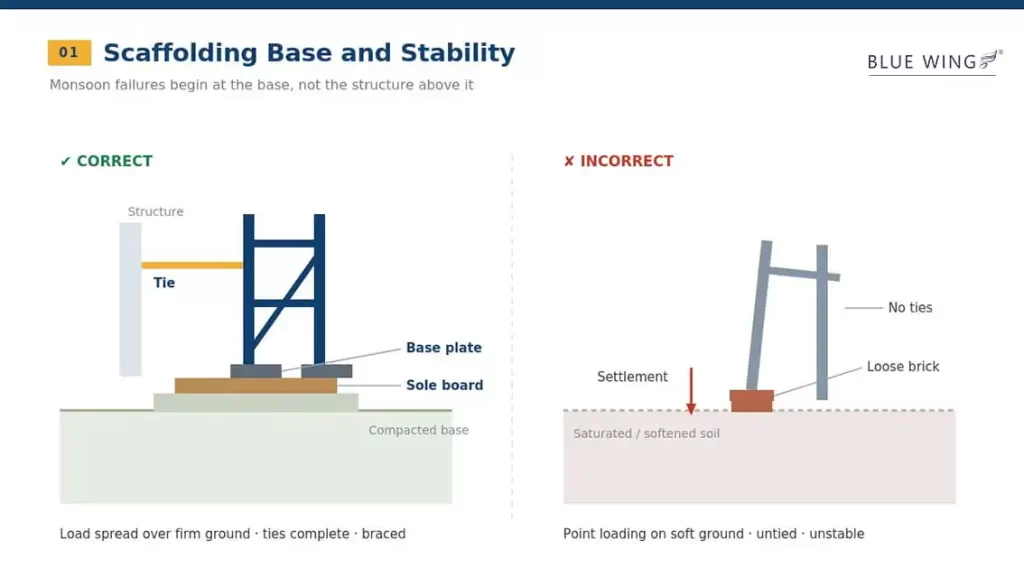
Scaffolding failures during monsoon almost always trace back to the base, not the structure above it.
Before the season begins:
- Confirm every standard sits on a sound base plate over a firm sole board — not directly on soil, and not on loose brick or stacked material
- Check that sole boards are on ground that will not turn to slurry. Where there is any doubt, provide a lean concrete or compacted hardcore bed
- Verify that ties to the permanent structure are complete and at the correct spacing. Sheeted scaffolds carry far higher wind loads, and this is where inadequate tying gets exposed
- Replace any corroded couplers or damaged boards. Corrosion accelerates sharply in continuous damp
During the season, check weekly and after every heavy spell:
- Re-level and re-inspect base plates. Settlement of even 15–20 mm at one standard changes load distribution across the bay
- Look for scour or washout around the scaffold base where run-off has been channelling
- Inspect all boards for movement and ensure toe boards are intact
- Remove accumulated water from any horizontal surface where it can pond
On monitoring wind: If sheeting or netting is fixed to the scaffold, treat it as a sail. During strong squalls, either the sheeting comes off or work at height stops. Both are acceptable. Continuing as normal is not.
2. Site Drainage and Water Management
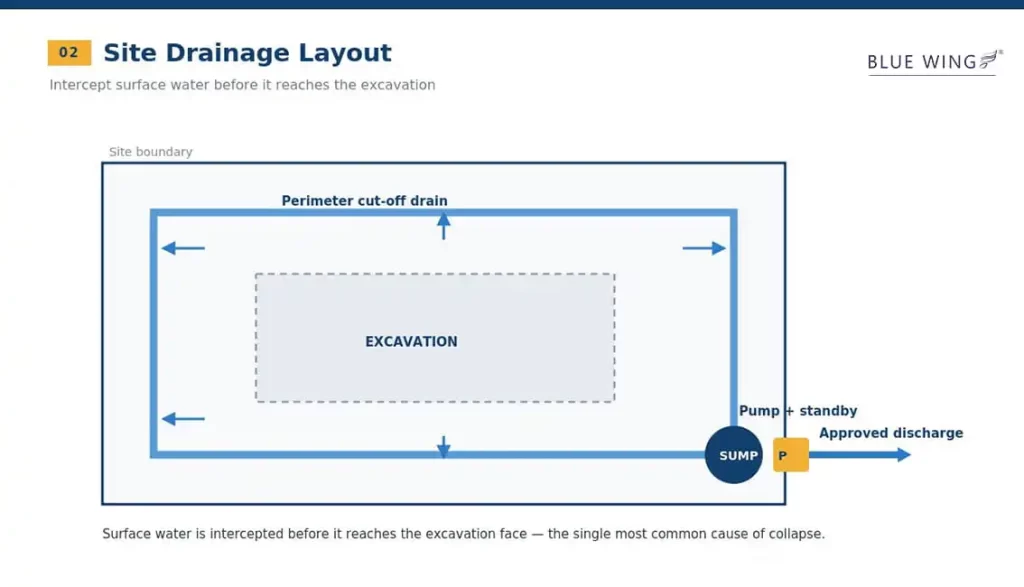
Drainage is the single highest-return item on this list, because standing water is what makes every other hazard worse.
Set up before the first rains:
- Establish a defined drainage layout for the site — where water enters, where it collects, where it discharges. Confirm the discharge point is legal and will not flood a neighbouring property
- Cut perimeter drains around excavations to stop surface run-off flowing into them. Water entering an excavation from above is the most common cause of face collapse
- Position sumps at the low points, with pumps sized for realistic peak rainfall, not average rainfall
- Keep standby pumps and spare hoses on site. A pump failure at 2 a.m. during a heavy spell is a serious event, not an inconvenience
Maintain through the season:
- Clear drains and sumps of silt and debris weekly. They silt up faster than most site teams expect
- Check that excavation faces are battered back or shored appropriately for saturated ground conditions. The angle that was safe in dry soil is not the angle that is safe in wet soil
- Where deep excavation work is under way, water control becomes part of the structural design rather than a housekeeping task. On projects with basements below the water table, this is exactly why techniques such as diaphragm walling are specified in the first place
- Maintain a dry, defined pedestrian route across the site. If workers are wading, someone will eventually take a shortcut across an unsafe area
3. Electrical Safety in Wet Conditions
This is where monsoon incidents turn fatal rather than merely expensive.
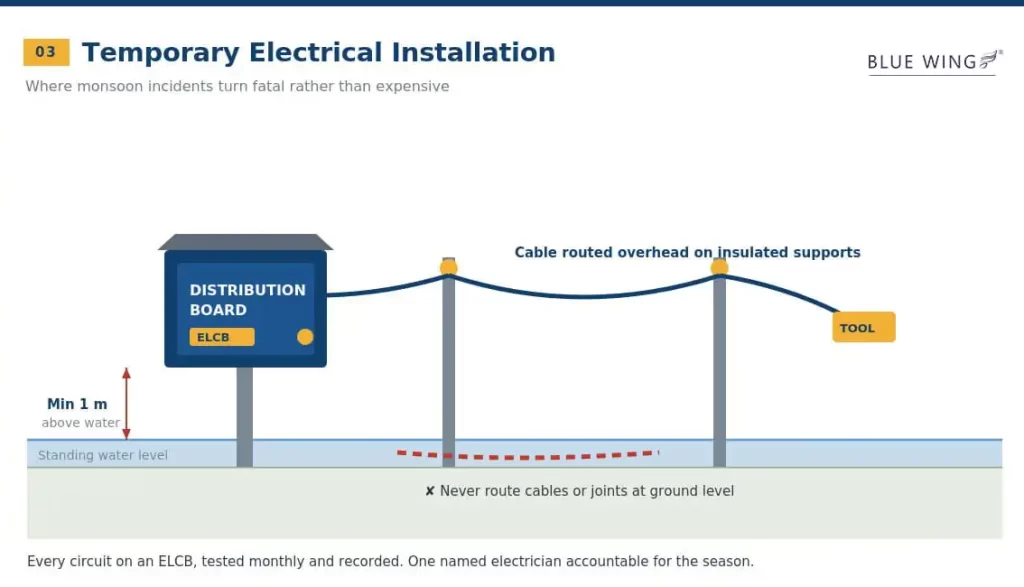
- All temporary distribution boards must be weatherproof, lockable and mounted well clear of ground level — a minimum of 1 metre above the highest expected water level on site
- Every circuit protected by an earth leakage circuit breaker, tested at the start of the season and re-tested monthly. Record the tests
- No joints or connections lying on the ground. Cables routed overhead on insulated supports, or in ducts if they must run at ground level
- Inspect all portable tools before each shift for damaged leads and cracked casings. Withdraw anything doubtful immediately
- Confirm earthing continuity across all equipment, including the site office and batching plant
- Stop all work involving portable electrical equipment during lightning activity, particularly on tower cranes and elevated steelwork
Assign one named electrician responsibility for the temporary installation for the whole season. Shared responsibility for temporary power is how faults go unreported.
4. Material Storage and Handling
Material losses during monsoon are usually treated as a commercial problem. Several of them are safety problems.
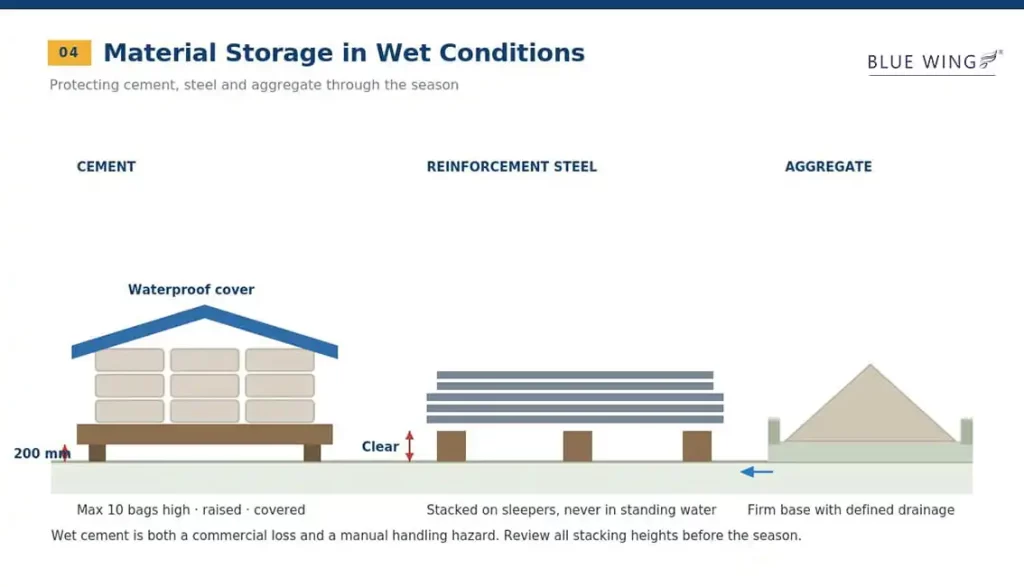
- Cement on raised platforms at least 200 mm clear of the floor, under waterproof cover, stacked no more than ten bags high. Wet bags harden and become both a waste item and a manual handling risk
- Reinforcement steel off the ground on sleepers. Surface rust is manageable; steel sitting in standing water for weeks is not
- Aggregate and sand stockpiled on a firm base with defined drainage, so moisture content stays within a range the mix design can accommodate
- Formwork and plywood stored flat and covered. Warped shuttering causes both defects and unsafe striking operations
- Chemicals and fuels in bunded storage clear of any area that can flood
- Review all stacking heights before the season. A stack that was stable on dry ground can lean or topple once the ground beneath it softens
The Daily Monsoon Routine
A checklist only works if someone runs it. The following takes about twenty minutes each morning and prevents most of what would otherwise become an incident report:
- Walk the drainage line — inlets, sumps, pumps, discharge
- Check excavation faces for cracking, bulging or slumping
- Inspect scaffold bases at the points where water collects
- Confirm distribution boards are secure, dry and locked
- Verify pedestrian access routes are passable and not flooded
- Check that covers over stored materials survived the night
- Brief the day’s workforce on which areas are restricted
Record it. A signed daily inspection sheet is both a genuine control measure and the documentation that matters if a question is ever raised later.
Safety as a Commercial Question
For developers and industrial clients evaluating a contractor, monsoon preparedness is a reasonable proxy for how a site is run generally. A contractor with a documented seasonal safety routine, a named person accountable for temporary power, and standby dewatering capacity is a contractor whose programme dates mean something.
Rain does not have to cost weeks. Unmanaged rain does.
At BlueWing Design & Construction, seasonal risk planning is built into our project methodology across our turnkey construction projects. Our sites operate under documented safety procedures in line with the National Building Code and BOCW requirements, supported by our ISO-certified quality systems.
The same discipline shows up in our completed projects, where programme dates held through multiple monsoon seasons.
FAQs:
Not usually. Most activities can continue safely with proper drainage, protected electrical systems and revised excavation support. Work at height, crane operations and concrete pours are the activities most often paused during heavy spells.
Excavation collapse caused by surface water entering the excavation, and electrical incidents involving temporary distribution equipment. Both are preventable with pre-season preparation.
Weekly as a minimum, and after every period of heavy rain or strong wind. Base plates and ground conditions need particular attention.
Light rain can be managed with covers and adjusted mix design. Heavy rain should stop the pour, as surface water changes the water-cement ratio and weakens the finished concrete.