

Appointing a contractor is the single decision that most determines whether a project finishes on time, on budget and to the standard you expected. It is also a decision most clients make with incomplete information — comparing quotations that are not really comparable, from firms whose actual track record is difficult to verify.
Ahmedabad has a deep contractor market, from single-crew operators to firms executing multi-crore industrial and commercial work. That depth is an advantage, but it makes filtering harder.
This guide sets out what to verify before you shortlist, how to compare quotations meaningfully, and the warning signs that appear well before a project goes wrong.
First, Define What You Are Actually Buying
Before approaching anyone, be clear on the scope you want priced. Clients often approach contractors with a partially defined project and then find the quotations impossible to compare.
At minimum, settle:
- The scope boundary. Does the contractor handle design, or are you supplying drawings? Are civil, MEP, interiors and external development included or separate?
- The contracting model. Item-rate, lump-sum turnkey, or EPC. This affects who carries the risk of quantity variation, and it is the most common source of dispute later.
- The programme. Your required completion date, and whether it is genuinely fixed or has flexibility.
- The quality benchmark. “Good quality” means nothing in a contract. Specify materials, finishes and applicable codes.
A contractor who asks these questions before quoting is generally more reliable than one who returns a figure within a day. A fast quotation on a loosely defined scope is usually a quotation that will be revised upward later.
Six Things to Verify Before Shortlisting
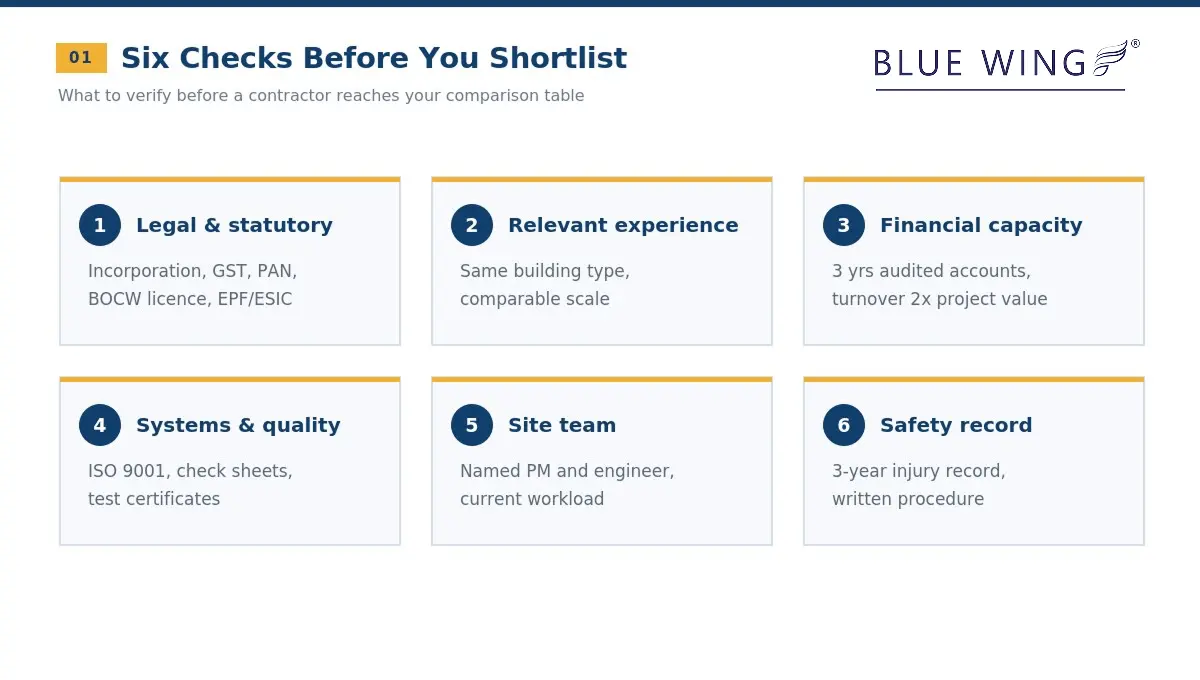
1. Legal and statutory standing
Confirm the firm is a registered legal entity, and ask for GST registration, PAN and the certificate of incorporation. For projects of any scale, verify labour licence registration under the BOCW Act and check that they are compliant with EPF and ESIC obligations for their workforce.
This matters commercially, not just ethically. Statutory non-compliance by your contractor can become your problem during occupancy approvals or in the event of a site incident.
2. Relevant experience — not just total experience
Twenty years of residential work does not qualify a firm for an industrial project with heavy foundations, and vice versa. Ask for completed projects in your specific building type, at a comparable scale.
Where your project involves specialist work — deep basements, poor soil conditions, or techniques such as diaphragm walling — confirm whether the contractor executes it in-house or subcontracts it. Both are acceptable. Not knowing which you are getting is not.
3. Financial capacity
A contractor whose turnover is a small multiple of your project value will struggle if payments slip or material prices move. Ask for audited financials for the past three years, and check that annual turnover is comfortably above your project value — a common benchmark is at least twice.
Also ask what other projects they are running concurrently. A firm at full capacity will not have the site management depth your project needs.
4. Certifications and systems
ISO 9001 certification indicates documented quality processes. ISO 14001 and ISO 45001 cover environmental and occupational safety management. These are not guarantees of good work, but they do indicate that the firm has systems rather than relying on individual site engineers.
Ask what those systems actually produce: quality check sheets, pour cards, material test certificates, daily progress reports. Ask to see samples from a live project.
5. Site management and team
Ask specifically who will run your project. Not the directors who attend the meeting — the project manager and site engineer who will be there daily.
Ask about their qualifications, their current workload, and whether they are permanent employees or engaged for this project. High reliance on temporary site staff is a genuine risk indicator.
6. Safety record
Ask directly: what is your lost-time injury record over the past three years, and what is your documented safety procedure?
A firm that has thought about this will answer immediately. A firm that has not will give you a general reassurance. That difference tells you a great deal about how the site will actually be run.
Understanding the Contract Structure
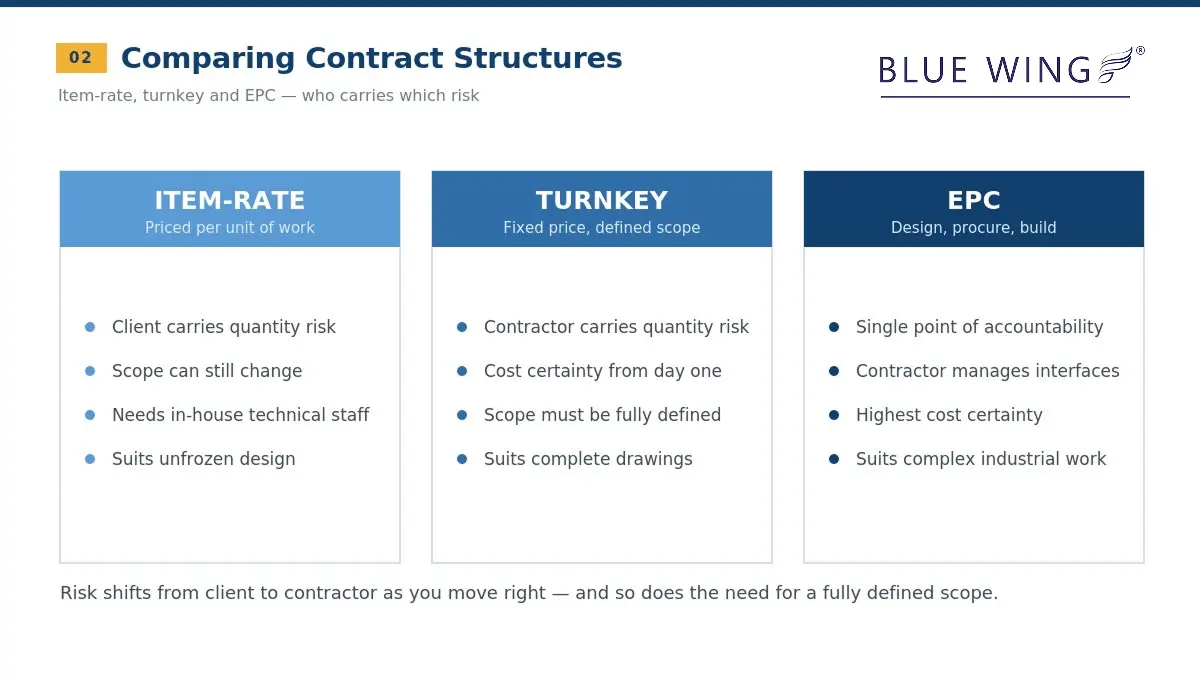
The contracting model determines who carries which risk. Choose deliberately.
Item-rate contracts price each item of work at a unit rate, with final cost based on actual measured quantities. You retain flexibility to vary scope, but you also carry the cost risk of quantity increases. Suitable where design is not fully frozen, provided you have the technical capacity to verify measurements.
Lump-sum turnkey contracts fix a single price for a defined scope. The contractor carries quantity risk. This gives cost certainty but demands a properly defined scope at the outset — every ambiguity becomes a variation claim. Most commercial and industrial clients working on a turnkey or EPC basis choose this route for exactly that cost certainty.
EPC contracts extend the turnkey model to include engineering and procurement, giving you a single point of accountability from design through commissioning. Appropriate for industrial facilities and complex projects where interface management between multiple agencies would otherwise fall to you.
There is also a growing case for precast construction on projects where programme certainty matters more than upfront cost — factory-produced elements reduce weather dependency and site labour requirements, though they demand earlier design freeze.
None of these is universally better. The right choice depends on how well defined your design is, how much cost certainty you need, and how much technical capacity you have in-house.
How to Compare Quotations Properly
The lowest quotation is the most common cause of the most expensive project. This is not a slogan — it is a predictable mechanism.
A contractor who wins on an unrealistically low bid has three ways to recover margin: substitute cheaper materials, claim variations aggressively, or slow work while pursuing other projects. All three cost you more than the difference you saved.
When comparing:
- Normalise the scope first. Check that all quotations cover identical inclusions. Differences in exclusions explain most price gaps.
- Look at the rate breakup, not just the total. A total can hide an unworkably low rate on one major item.
- Check the exclusion list carefully. This is where an apparently cheap quotation reveals itself.
- Query anything significantly below the others. Ask how the rate was arrived at. A credible contractor will explain it.
- Confirm the price validity period and what happens if material prices move.
If one quotation is 20% below the rest, the burden is on that contractor to explain why — not on you to assume they are simply more efficient.
Warning Signs During the Tender Stage
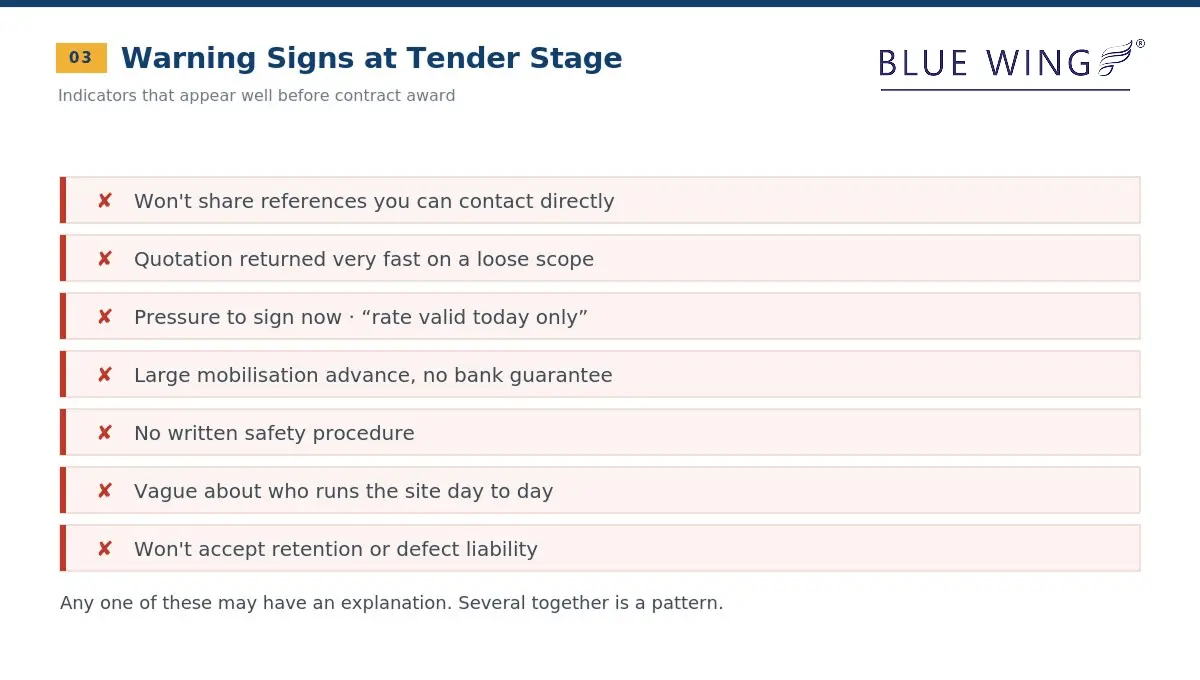
Some indicators appear well before contract award:
- Reluctance to share completed project references, or references you cannot contact directly
- A quotation returned very quickly on a loosely defined scope
- Pressure to sign quickly, or a “rate valid today only” approach
- Requests for a large mobilisation advance without a bank guarantee
- No written safety procedure
- Vagueness about who will manage the site day to day
- Unwillingness to accept a retention clause or defect liability period
Any one of these may have an explanation. Several together is a pattern.
Questions Worth Asking Directly
Take these to the meeting:
- Which projects comparable to mine have you completed in the last three years, and may I visit one?
- Who is the project manager, and how many other projects are they currently running?
- What is your safety record, and what is your written procedure?
- What is your standard defect liability period?
- How do you handle variations and what is the approval process?
- What are the exclusions in this quotation?
- What is your current order book, and where would my project sit in your priorities?
Question 7 is the one clients most often skip and most often regret. A capable contractor operating beyond capacity will deliver worse results than a smaller firm with room for your project.
Checking References Properly
Ask for three completed projects and contact the clients directly. Ask them:
- Did the project finish on the original programme? If not, why?
- What was the final cost against the contract value?
- How were problems handled when they arose?
- Would you appoint them again?
Then visit a live site unannounced if you can. Fifteen minutes on an active site tells you more about a contractor’s standards than any presentation — look at housekeeping, material storage, whether workers are wearing protective equipment, and whether the site engineer can answer questions about the day’s work.
A Note on Local Knowledge
For projects in Ahmedabad and across Gujarat, local execution experience carries real weight. Expansive clay soils affect foundation design across much of the region. AUDA and GDCR approval processes have their own rhythms. Monsoon programming, labour availability around festival periods, and established material supply relationships all affect delivery.
A contractor who has executed repeatedly in the region has priced these realities into their programme. One who has not will discover them during your project.
Making the Decision
Weight your decision roughly as follows: relevant experience and technical capability first, financial and organisational capacity second, price third. Price matters — but it is the factor most likely to be misleading in isolation, because it is the only one that can be misrepresented simply by writing a smaller number.
At BlueWing Design & Construction, we work with clients on turnkey and EPC basis across industrial, commercial and institutional projects in Gujarat, supported by ISO-certified quality systems. The projects we have delivered span pharmaceutical facilities, corporate headquarters, educational campuses and industrial plants.
Evaluating contractors for an upcoming project? Talk to our team — we are glad to discuss scope and approach, whether or not we end up being the right fit.
FAQs:
Rates vary widely by building type, specification and contract structure, so any single figure is misleading. What matters more is comparing quotations on identical scope, with the exclusion list checked carefully — differences in exclusions explain most apparent price gaps.
A turnkey contractor delivers a defined scope for a fixed price. An EPC contractor additionally takes responsibility for engineering and procurement, giving a single point of accountability from design through commissioning. EPC suits complex industrial projects; turnkey suits projects where design is already largely complete.
Not without understanding why it is lowest. A quotation significantly below the others usually reflects a narrower scope, lower specification, or a bid the contractor intends to recover through variations. Ask the contractor to explain how the rate was arrived at.
Certificate of incorporation, GST and PAN registration, audited financials for three years, labour licence under the BOCW Act, EPF and ESIC compliance, ISO certifications if claimed, and completed project references you can contact directly.
Twelve months from completion is common for general building work, though this varies by contract and by element. Waterproofing and structural elements often carry longer periods. Confirm it in writing before award.